


What Applying Systems Thinking Tells Us About the GFCC Human Edge Report
Societies have entered a new paradigm shaped by AI's impact on work, life, and learning. To unpack this reality, the GFCC and Torrens University Australia launched The Human Edge: Global Perspectives on AI and Prosperity last July, a report exploring how leaders across 32 countries view the human-AI transition and where governments, businesses, universities, and other stakeholders should invest to achieve shared prosperity.
Systems thinking consultant and professor Aurélio L. Andrade applied the discipline to the report's results, using visual tools, archetypes, and other concepts to reveal the relationships between factors shaping the human-AI evolution.
Through a modeling framework, strongly based on the use of visual representations of the various elements of the system, he analyses how different variables interact and connect. This methods allows users to understand how factors reinforce one another over time, rather than isolating a single cause for a single effect.
"Written text has a limitation: it cannot fully capture the relationships between the variables that shape a result. A visual mapping tool makes those relationships visible and helps identify leverage points, strategies to achieve better results with less effort," explains Andrade.
What Is Systems Thinking?
Originally developed by Jay Forrester at the MIT in the 1950’s, systems thinking is a conceptual and scientific paradigm that applies a holistic view to societal and organizational problems. Applying visual language and reframing analysis around feedback loops, delays, and structure, this approach shifts the question from "what caused this result?" to "what structure is producing this pattern?".
This shift changes where attention is directed and where interventions are made. It also helps analysts identify leverage points where strategies can be applied to produce the best results with the least effort.
Andrade highlights that system structures are often "counterintuitive." They reveal that the places farthest from the center of a discussion are frequently where the smallest effort can yield the greatest results.
That happens because attention naturally concentrates on the symptom being debated, while the structure actually producing it tends to run through parts of the system that get far less scrutiny — a policy, an incentive, or a delay operating quietly upstream.
Systems thinking can be useful when assessing and planning competitiveness strategies. Its proposed ecosystem view can account for how institutions, capital, education, policy, and R&D interact in a framework that also considers uncertainty and subjectivity.
Applying Systems Thinking Archetypes to the Human Edge
Systems archetypes are recurring patterns of behavior that show up repeatedly in complex systems — whether in organizations, economies, or ecosystems — regardless of the specific situation involved. Visually, archetypes are patterns of relationships and connections represented by links connecting two variables.
The insight behind them is simple: the same underlying structures of reinforcing and balancing feedback loops tend to produce the same kinds of problems in wildly different contexts. Instead of treating every problem as unique, archetypes give analysts a template to recognize patterns, which helps diagnose root causes rather than just treating symptoms.
Using archetypes such as the "quick fix" (a response that addresses an immediate symptom without addressing the underlying cause) and "shifting the burden" (what happens when that quick fix becomes the preferred response over time), Andrade identifies patterns in the human-AI transition.
In the Human Edge, leaders agreed that AI is reshaping the nature of work, with the clearest value in freeing people from repetitive cognitive tasks. Yet the transition is outpacing the systems meant to prepare for it: 89% of respondents say education and workforce systems are preparing people poorly or somewhat inadequately, and skills mismatch ranks as the top barrier — ahead of ethics, bias, or regulatory clarity.
Additionally, the capabilities leaders rank highest are notably human: creativity, critical thinking, ethics, and adaptability outpace technical AI expertise itself. And the risk they flag most is not displacement but exclusion. Without deliberate attention, the Global South, low-skilled workers, and marginalized groups stand to fall further behind.
In reading the Human Edge with systems lens, Andrade noted that competitiveness pressure pushes organizations to adopt AI, and that adoption delivers a real, fast payoff in short-term — the "quick fix" loop:

But once locked into that fix, organizations can become dependent on it, creating a pattern in which rapid AI adoption is not matched by parallel investment in human capabilities.

This situation creates multiple societal risks, including unemployment among entry-level and mid-level roles. While AI can absorb entry-level work in the short term, the longer-term costs for talent development are concerning. Additionally, if people lose access to work, they lose the ability to consume, and a country's competitiveness and economy suffer as a result.
When human capability development functions well, it drives the kind of growth the system is meant to produce: shared prosperity. Human capability development strengthens human capacity, which strengthens human-centered competitiveness, which feeds shared and inclusive prosperity — and that prosperity, reinvested, strengthens human capability development again. Unlike the quick-fix loop, this is a cycle that compounds in the right direction the longer it runs:
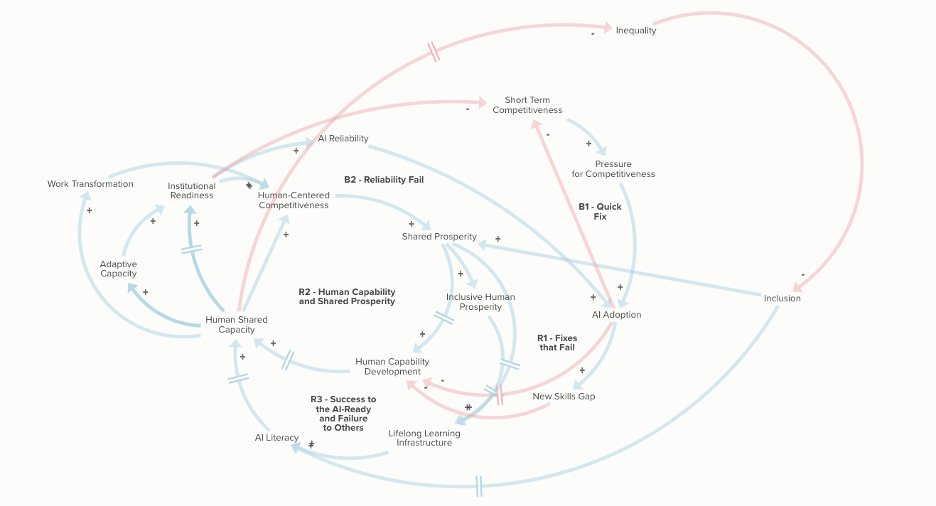
As Andrade points out, the map connects to the need to "democratize" institutions to build institutional readiness. Institutions need to become more effective, faster, and more flexible in their responses, since most institutions today are still bureaucratic and slow to adapt.
Put together, these loops — the quick fix, the fix that fails, the virtuous human-capability cycle, plus the reinforcing dynamics around dependency, inequality, and institutional adaptation that Andrade maps in later stages of the analysis — form a single integrated picture of the system:

The view reinforces the vision shared by leaders in the Human Edge report: shared prosperity depends less on how fast AI is adopted than on how quickly institutions adapt to use it effectively by investing in human capabilities.
The Human Edge set out to map how leaders across 32 countries are experiencing the AI transition, and its value lies as much in that structure as in its findings. Andrade’s systems thinking analysis makes the dynamics behind those findings visible — work that speaks directly to the practitioners who help companies, governments, and communities navigate the same transition.
For the GFCC, that connection matters: it signals that this content is proving useful to people actively building more productive, competitive, and prosperous institutions, systemically and for the benefit of the many rather than the few.

Comments